Grazing Principles
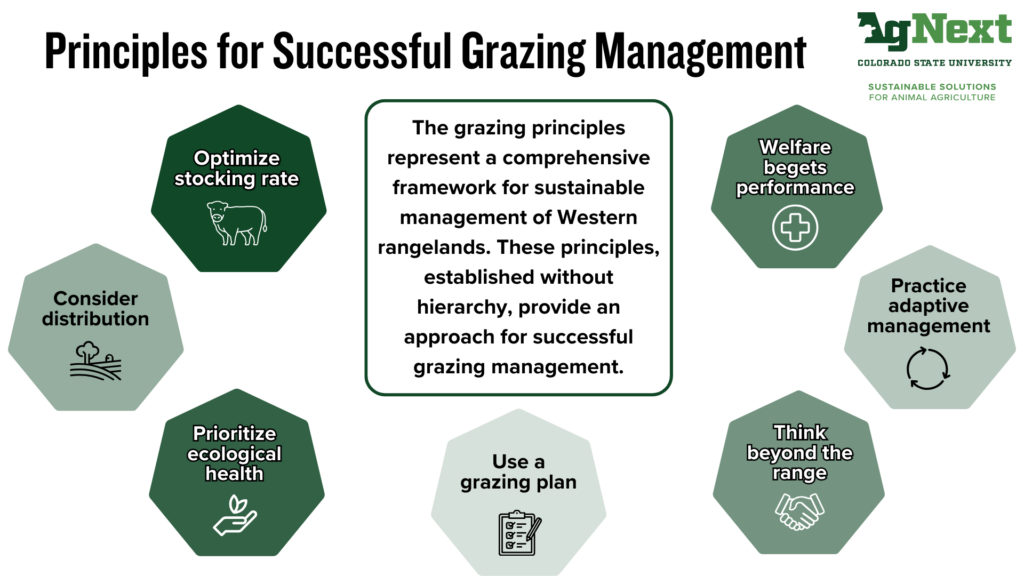
The expert team at AgNext has developed a guide to support successful grazing management in Western rangelands. The seven Grazing Principles are intended to serve as a flexible framework rather than a prescriptive set of requirements. While some operations may benefit from incorporating all seven principles, others may find value in applying only those most relevant to their management goals and conditions.
Building on the work of Jablonski et al. (2023), the AgNext team has developed a variety of tools and resources to help producers implement these principles within their own operations.
The Grazing Principles Guidebook
The Grazing Principles Guidebook provides a detailed overview of each of the seven principles of successful grazing management. Within the guidebook, readers will find practical explanations, additional resources, and tools to support implementation of each principle.
The Grazing Principles Checklist
The Grazing Principles Checklist serves as a practical companion to the Guidebook, helping producers assess their current management practices and track progress as they implement the seven Grazing Principles.
Kevin Jablonski, Ph.D.
Project Lead
Anna Shadbolt
Research Associate
Kim Stackhouse-Lawson, Ph.D.
Director
Reference:
Jablonski, K. E., Derner, J. D., Bailey, D. W., Davies, K. W., Meiman, P. J., Roche, L. M., Thacker, E. T., Vermeire, L. T., & Stackhouse-Lawson, K. R. (2024). Principles for successful livestock grazing management on western US rangelands. Rangelands, 46(2), 35-41. https://doi.org/10.1016/j.rala.2023.11.001
Key Scientific Literature:
Ahlering, M. A., Kazanski, C., Lendrum, P. E., Borrelli, P., Burnidge, W., Clark, L., Ellis, C., Gadzia, K., Gelbard, J., Gennet, S., Goodwin, J., Herrick, J. E., Kachergis, E., Knapp, C., Labbe, N., Maczko, K., Porzig, E., Rizzo, D., Spiegal, S., & Wilson, C., (2021). A Synthesis of Ranch-Level Sustainability Indicators for Land Managers and to Communicate Across the US Beef Supply Chain. Rangeland Ecology & Management, 79, 217–230.
Allen, C. R., Angeler, D. G., Fontaine, J. J., Garmestani, A. S., Hart, N. M., Pope, K. L., Twidwell, D. (2017). Adaptive Management of Rangeland Systems, in: Briske, D. D. (Ed.), Rangeland Systems: Processes, Management and Challenges, Springer Series on Environmental Management. Springer International Publishing.
Ash, A., Smith, D. (1996). Evaluating Stocking Rate Impacts in Rangelands: Animals Don’t Practice What We Preach. The Rangeland Journal. 18, 216.
ATTRA. (2017). Grazing Planning Manual and Workbook – ATTRA – Sustainable Agriculture. National Center for Appropriate Technology.
Bailey, D. W. (2005). Identification and Creation of Optimum Habitat Conditions for Livestock. Rangeland Ecology & Management, 58, 109–118.
Bailey, D. W., Trotter, M. G., Tobin, C., Thomas, M. G. (2021). Opportunities to Apply Precision Livestock Management on Rangelands. Frontiers in Sustainable Food Systems, 5.
Bailey, D. W., Lunt, S., Lipka, A., Thomas, M. G., Medrano, J. F., Cánovas, A., Rincon, G., Stephenson, M. B., Jensen, D. (2015). Genetic Influences on Cattle Grazing Distribution: Association of Genetic Markers with Terrain Use in Cattle. Rangeland Ecology & Management, 68, 142–149.
Bailey, D. W., Provenza, F. D. (2008). Mechanisms Determining Large-Herbivore Distribution, in: Prins, H.H.T., Langevelde, F.V. (Eds.), Resource Ecology, Wageningen UR Frontis Series. Springer Netherlands, pp. 7–28.
Pellant, M. L., Shaver, P. L., Pyke, D. A., Busby, F. E., Riegel, G., Lepak, N., Kachergis, E., Newingham, B. A., Toledo, D. (2018). Interpreting indicators of rangeland health, version 5 (No. 1734–6). U.S. Department of the Interior, Bureau of Land Management, National Operations Center, Denver, CO.
Bestelmeyer, B. T., Duniway, M. C., James, D. K., Burkett, L. M., Havstad, K. M., Suding, K., 2013. A test of critical thresholds and their indicators in a desertification-prone ecosystem: more resilience than we thought. Ecology Letters, 16, 339–345.
Blackshaw, J. K., Blackshaw, A. W. (1994). Heat stress in cattle and the effect of shade on production and behaviour: a review. Australian Journal of Experimental Agriculture, 34, 285–295.
Boone, R. B., Hobbs, N. T. (2004). Lines around fragments: effects of fencing on large herbivores. African Journal of Range & Forage Science 21, 147–158.
Boyd, C. S., Svejcar, T. J. (2009). Managing complex problems in rangeland ecosystems. Rangeland Ecology & Management, 62, 491–499.
Brunson, M. W., Huntsinger, L. (2008). Ranching As A Conservation Strategy: Can Old Ranchers Save The New West? Rangeland Ecology & Management, 61, 137–147.
Center for Collaborative Conservation. (2023). How To. Center for Collaborative Conservation. URL (accessed 4.18.23).
DelCurto, T., Hess, B. W., Huston, J. E., Olson, K. C. (2000). Optimum supplementation strategies for beef cattle consuming low-quality roughages in the western United States. Journal of Animal Science, 77, 1.
Derner, J. D., Augustine, D. J. (2016). Adaptive Management for Drought on Rangelands. Rangelands, Drought on Rangelands: Effects and Solutions. Rangelands, 38, 211–215.
Derner, J. D., Budd, B., Grissom, G., Kachergis, E. J., Augustine, D. J., Wilmer, H., Scasta, J. Derek, Ritten, J. P. (2022). Adaptive grazing management in semiarid rangelands: An outcome-driven focus. Rangelands, Adaptive Monitoring to Support Adaptive Management, 44, 111–118.
Díaz, S., Lavorel, S., McIntyre, S., Falczuk, V., Casanoves, F., Milchunas, D. G., Skarpe, C., Rusch, G., Sternberg, M., Noy-Meir, I., Landsberg, J., Zhang, W., Clark, H., Campbell, B. D. (2007). Plant trait responses to grazing – a global synthesis. Global Change Biology, 13, 313–341.
Fuhlendorf, S. D., Engle, D. M., Elmore, R. D., Limb, R. F., Bidwell, T. G. (2012). Conservation of Pattern and Process: Developing an Alternative Paradigm of Rangeland Management. Rangeland Ecology & Management, 65, 579–589.
Fuhlendorf, S. D., Fynn, R. W. S., McGranahan, D. A., Twidwell, D. (2017). Heterogeneity as the Basis for Rangeland Management, in: Briske, D.D. (Ed.), Rangeland Systems. Springer International Publishing, Cham, pp. 169–196.
George, M., Bailey, D., Borman, M., Ganskopp, D., Surber, G., Harris, N. (2007). Factors and Practices that Influence Livestock Distribution, Rangeland Management Series. University of California, Oakland, California.
Gosnell, H., Grimm, K., Goldstein, B. E. (2020). A half century of Holistic Management: what does the evidence reveal? Agricultural and Human Values, 37, 849–867.
Grandin, T., 2019. Low Stress Methods for Moving and Herding Cattle on Pastures, Paddocks, and Large Feedlot Pens. URL (accessed 4.18.23).
Grissom, G., Steffens, T. (2013). Case Study: Adaptive Grazing Management at Rancho Largo Cattle Company. Rangelands, 35, 35–44.
Hamilton, S., Garretson-Weibel, C., Mitchell, J., Smith, M., Powell, D., Quimby, C., Fults, G., Stanley, C., Tanaka, J., Maczko, K. (2011). Sustainable Ranch Management Assessment Guidebook. University of Wyoming Cooperative Extension.
Havstad, K. M., Peters, D. P. C., Skaggs, R., Brown, J., Bestelmeyer, B., Fredrickson, E., Herrick, J., Wright, J. (2007). Ecological services to and from rangelands of the United States. Ecological Economics, Special Section – Ecosystem Services and Agriculture, 64, 261–268.
Herrick, J. E., Zee, J. W. V., Havstad, K. M., Burkett, L. M., Whitford, W. G. (2005). Monitoring manual for grassland, shrubland and savanna ecosystems. Volume I: Quick Start. Volume II: Design, supplementary methods and interpretation.
Holechek, J. L. (1988). An Approach for Setting the Stocking Rate. Rangelands, 10, 10–14.
Hunt, L. P., McIvor, J. G., Grice, A. C., Bray, S. G., McIvor, J. G., Grice, A. C., Bray, S. G. (2014). Principles and guidelines for managing cattle grazing in the grazing lands of northern Australia: stocking rates, pasture resting, prescribed fire, paddock size and water points – a review. The Rangeland Journal, 36, 105–119.
Knapp, C. N., Fernandez-Gimenez, M. E. (2009). Knowledge in Practice: Documenting Rancher Local Knowledge in Northwest Colorado. Rangeland Ecology and Management, 62, 500–509.
Knight, R. L. (2007). Ranchers as a Keystone Species in a West That Works. Rangelands, 29, 4–9.
Launchbaugh, K. L., Howery, L. D. (2005). Understanding landscape use patterns of livestock as a consequence of foraging behavior. Rangeland Ecology & Management, 58, 99–108.
Launchbaugh, K. (2017). Guidelines for Setting a Proper Stocking Rate. University of Idaho.
Leroy, F., Abraini, F., Beal, T., Dominguez-Salas, P., Gregorini, P., Manzano, P., Rowntree, J., van Vliet, S. (2022). Animal board invited review: Animal source foods in healthy, sustainable, and ethical diets – An argument against drastic limitation of livestock in the food system. animals 16, 100457.
NOAA (2023). Intermountain West Climate Dashboard | Western Water Assessment. URL. (accessed 4.17.23).
Provenza, F. D., Villalba, J. J., Dziba, L. E., Atwood, S. B., Banner, R. E. (2003). Linking herbivore experience, varied diets, and plant biochemical diversity. Small Ruminant Research, Advanced research on nutrition of sheep and goats, with special reference to pasture and rangeland use, 49, 257–274.
Raynor, E. J., Bruegger, R. (2020). Early Warning for Stocking Decisions in Eastern Colorado (No. 3.115). Colorado State University Extension.
Roche, L. (2016). Adaptive Rangeland Decision-Making and Coping with Drought. Sustainability, 8, 1334.
Sayre, N. F., deBuys, W., Bestelmeyer, B. T., Havstad, K. M. (2012). “The range problem” after a century of rangeland science: new research themes for altered landscapes. Rangeland Ecology & Management, 65, 545–552.
Sayre, N. F., McAllister, R. R., Bestelmeyer, B. T., Moritz, M., Turner, M. D. (2013). Earth Stewardship of rangelands: coping with ecological, economic, and political marginality. Frontiers in Ecology and the Environment, 11, 348–354.
Steffens, T., Grissom, G., Barnes, M., Provenza, F., Roath, R. (2013). Adaptive Grazing Management for Recovery: Know why you’re moving from paddock to paddock. Rangelands, 35, 28–34.
Stephenson, M. B., Bailey, D. W., Bruegger, R. A., Howery, L. D. (2017). Factors Affecting the Efficacy of Low-Stress Herding and Supplement Placement to Target Cattle Grazing Locations. Rangeland Ecology & Management, 70, 202–209.
Torell, L. A., Murugan, S., Ramirez, O. A. (2010). Economics of Flexible Versus Conservative Stocking Strategies to Manage Climate Variability Risk. Rangeland Ecology & Management, 63, 415–425.
USDA ARS (2023). Rangeland Analysis Platform. Rangeland Analysis Platform. URL (accessed 4.17.23).
USDA-ARS, USDA NRCS, NMSU (2023). Ecological site descriptions. URL (accessed 4.18.23).
Wagner, J. J., Engle, T. E. (2021). Invited Review: Water consumption, and drinking behavior of beef cattle, and effects of water quality. Applied Animal Science, 37, 418–435.
Western SARE. (2017). Rangeland Management Strategies. USDA.
Williams, B. K., Szaro, R. C., Shapiro, C. D. (2009). Adaptive management: The U.S. Department of the Interior technical guide (Report). Washington, D.C.
Wilmer, H., Porensky, L., Fernández-Giménez, M., Derner, J., Augustine, D., Ritten, J., Peck, D. (2019). Community-Engaged Research Builds a Nature-Culture of Hope on North American Great Plains Rangelands. Social Sciences, 8, 22.